
Khula Without Husband’s Consent: A Revolutionary Landmark for Women’s Rights
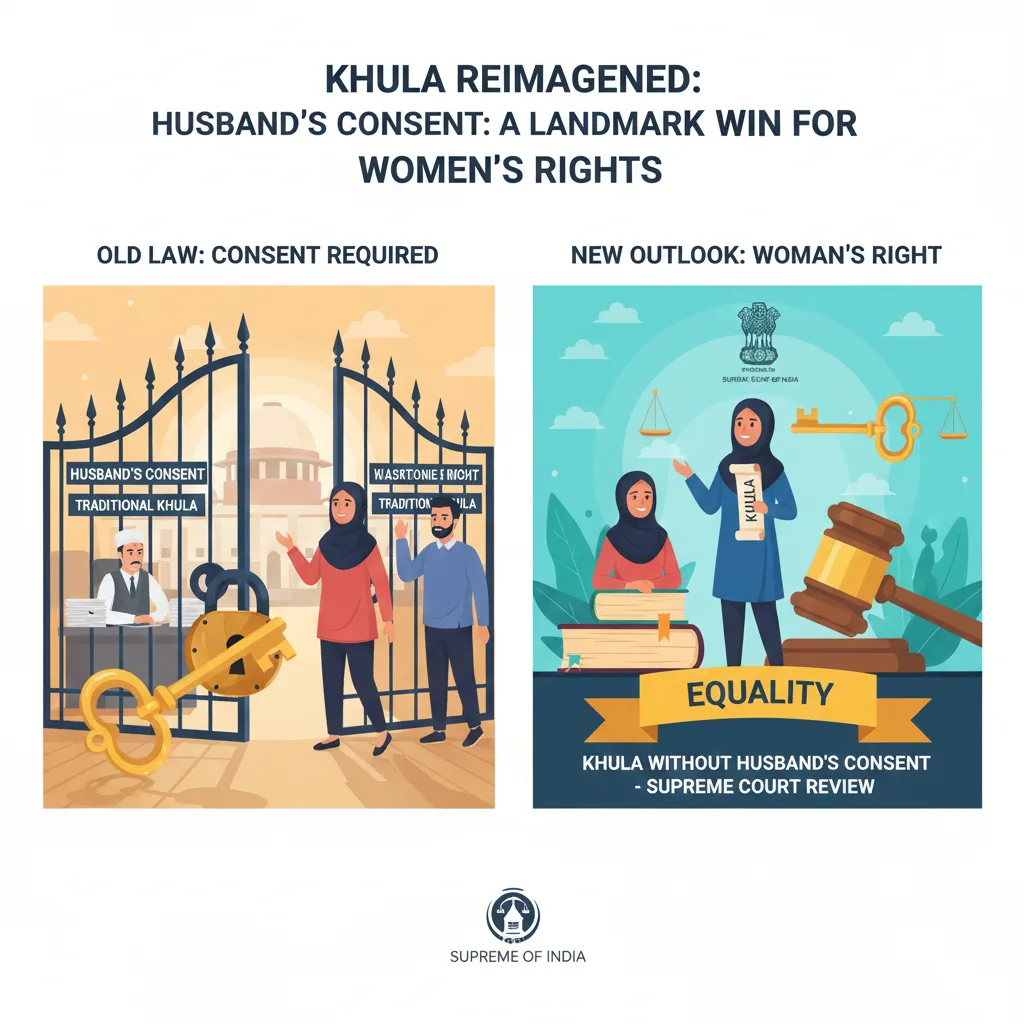
A revolutionary shift in Indian Personal Law: Redefining matrimonial autonomy.
Executive Summary
The Supreme Court of India is currently deliberating a transformative legal question: Is the right to Khula Without Husband’s Consent absolute? By examining a groundbreaking Kerala High Court verdict, the apex court seeks to determine if Muslim women possess the same unilateral divorce rights as men, free from the constraints of hegemonic masculinity.
The legal landscape of Muslim Personal Law in India is approaching a revolutionary milestone. For years, the procedure of Khula has been debated in religious and legal circles—specifically, whether it requires a “mutual agreement” or if it is a unilateral power. The Supreme Court of India has now stepped in to decide if a woman has the absolute right to terminate her marriage through Khula Without Husband’s Consent.
This judicial intervention is a direct response to a massive appeal against a bold Kerala High Court ruling. That judgment didn’t just interpret law; it championed the constitutional values of equality and individual agency over archaic procedural hurdles.
The Kerala High Court’s Bold Verdict: Breaking the Chains
The core of the dispute lies in the interpretation of the Holy Quran. The Kerala High Court held that the right to Khula Without Husband’s Consent is not a “permission” to be sought from the spouse, but a right granted directly to the wife. Just as a husband exercises ‘Talaq’ unilaterally, the court argued that the wife must have a corresponding right via ‘Khula’.
The justices famously remarked that the opposition to a wife’s unilateral right often stems from a mindset of “hegemonic masculinity.” By asserting that Khula is a female-initiated divorce that does not depend on the husband’s approval, the court sought to dismantle the idea of women as subjects of their husbands.
3 Essential Conditions for Valid Khula
While the right to Khula Without Husband’s Consent is powerful, it is not without a defined legal framework. To ensure fairness, the court established three non-negotiable steps:
- The Declaration: The wife must formally declare her intent to repudiate the marriage.
- The Restitution (Return of Mahr): The wife must offer to return the dower (Mahr) or any material gains received during the marriage, essentially “buying back” her freedom.
- The Reconciliation Attempt: Before the finality of the divorce, there must be a genuine attempt at mediation or reconciliation to save the marital bond if possible.
Why the Supreme Court Intervention is Crucial
The petitioner in the Supreme Court (the husband) argues that the High Court’s ruling bypasses the Dissolution of Muslim Marriages Act, 1939. He contends that if a wife wishes to divorce without consent, she must move through a Qazi or a civil court. However, the High Court argued that judicial intervention is only necessary when the husband *disputes* the conditions of Khula, not for the act of divorce itself.
Recognizing the massive impact of Khula Without Husband’s Consent on Indian society, the Supreme Court bench has appointed Senior Advocate Shoeb Alam as Amicus Curiae. The goal is to balance ancient religious texts with the modern Indian Constitution’s mandate for gender equality.
| Feature | Traditional/Clergy View | Progressive 2026 Outlook |
|---|---|---|
| Consent Requirement | Husband must agree or “grant” it. | Absolute Right of the Wife. |
| Legal Bottleneck | Years of litigation in family courts. | Extra-judicial and instant (if conditions met). |
Understanding these shifts is vital for anyone navigating family law in India today. For more detailed insights, explore our guide on Matrimonial Rights and Personal Law.
What’s Next? The April 22nd Hearing
The Supreme Court has scheduled a regular hearing for April 22, 2026. The verdict will settle a long-standing civil debate: Is a Muslim woman an independent legal entity capable of ending her own marriage, or is she perpetually dependent on male consent?
By upholding Khula Without Husband’s Consent, the court would essentially confirm that marriage in Islam is a contract that either party can end—provided they fulfill their respective contractual obligations (like the return of Mahr).

Final Thoughts
This case represents a triumph of autonomy over tradition. If the Supreme Court validates the Kerala High Court’s stance, it will offer immediate relief to thousands of women stuck in dead marriages. It serves as a reminder that while religious traditions are respected, they must coexist with the modern democratic spirit of 2026.
Share this revolutionary update: