
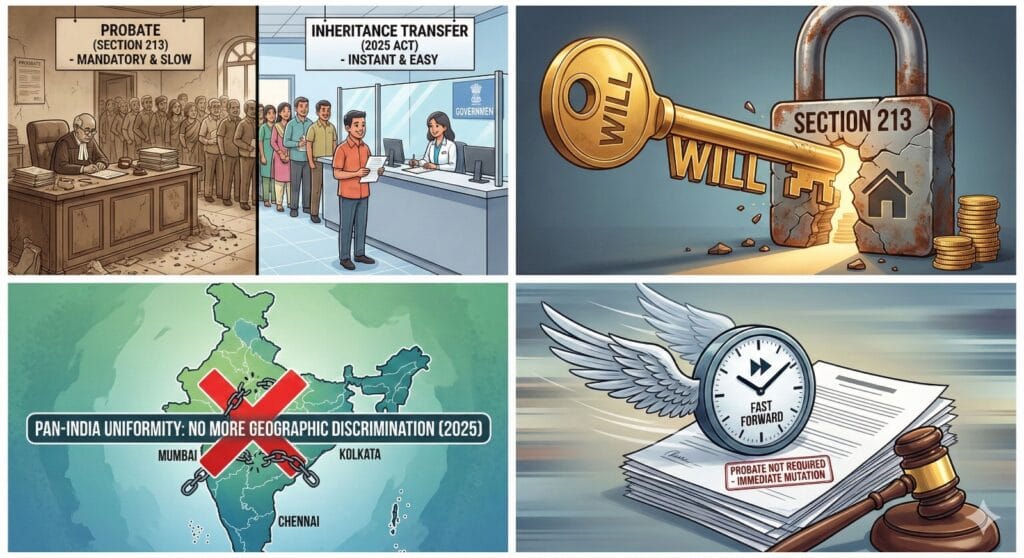
Probate in India 2026: The Easy Guide to Unlock Inheritance
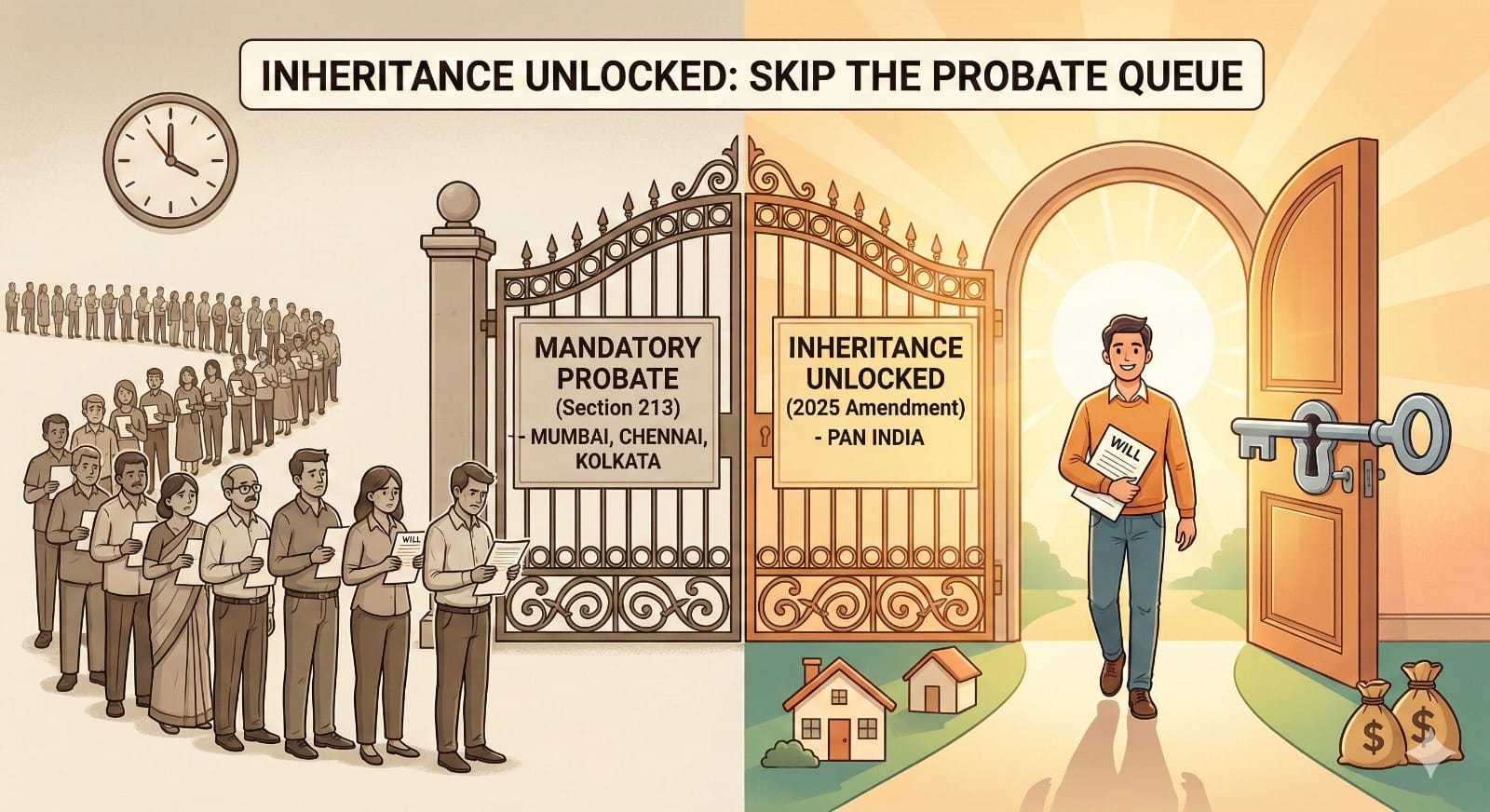
The “Probate Raj” ends: A new era for property inheritance in India’s historic metros.
Executive Summary
The rules for Probate in India 2026 have fundamentally changed. With the passing of the Repealing and Amending Act, 2025, the mandatory requirement for probate under Section 213 has been omitted, making asset transfer easy and instant.
If you are looking for information on Probate in India 2026, you likely know the struggle. For nearly a century, inheriting property in India’s most historic metropolises came with a hidden, cumbersome “tax” on both time and money.
If you lived in Mumbai, Chennai, or Kolkata, simply possessing a valid, registered Will was often not enough. Section 213 of the Indian Succession Act, 1925 acted as a rigid gatekeeper. However, the landscape for inheritance is now entirely different following this recent amendment.
This requirement previously created a unique paradox: A beneficiary in Delhi could transfer a title with a simple affidavit, while a beneficiary in South Mumbai had to navigate the High Court. With the omission of Section 213, Probate in India 2026 has become the trending topic for every property owner looking for relief.
But what does this mean for your family practically? Here are the three most compelling reasons why the new rules let you skip the queue.
1. Speed: How the New Rules Save Time
The most punishing aspect of the old regime was the sheer loss of time. Under Section 213, obtaining a court order was a full-fledged judicial process. Even for an uncontested Will, families waited months.
In overburdened High Courts like Bombay or Madras, this “formality” often dragged on for 12 to 18 months. If a citation was unserved, it took years. The reforms to Probate in India 2026 mean the “waiting period” is effectively zero.
The New Reality: You no longer need a judicial stamp. You can now approach municipal authorities directly with the original Will. This is the biggest advantage of the updated guidelines.
2. Massive Cost Savings on Probate in India 2026
The legal process wasn’t just slow; it was prohibitively expensive. The cost of complying with the old laws often felt like a second tax on inheritance. This is where the changes to Probate in India 2026 truly shine.
First, there were the Court Fees, often calculated ad valorem (according to value). Second, there were Professional Fees for specialized counsel. By removing the mandatory requirement, this becomes a zero-cost affair for many.
| Expense Head | Old Regime (Mandatory) | New 2026 Rules |
|---|---|---|
| Court Fees | Up to ₹75,000+ (or % of value) | ₹0 (Optional) |
| Legal Fees | High (Specialized Counsel) | Reduced (Drafting only) |
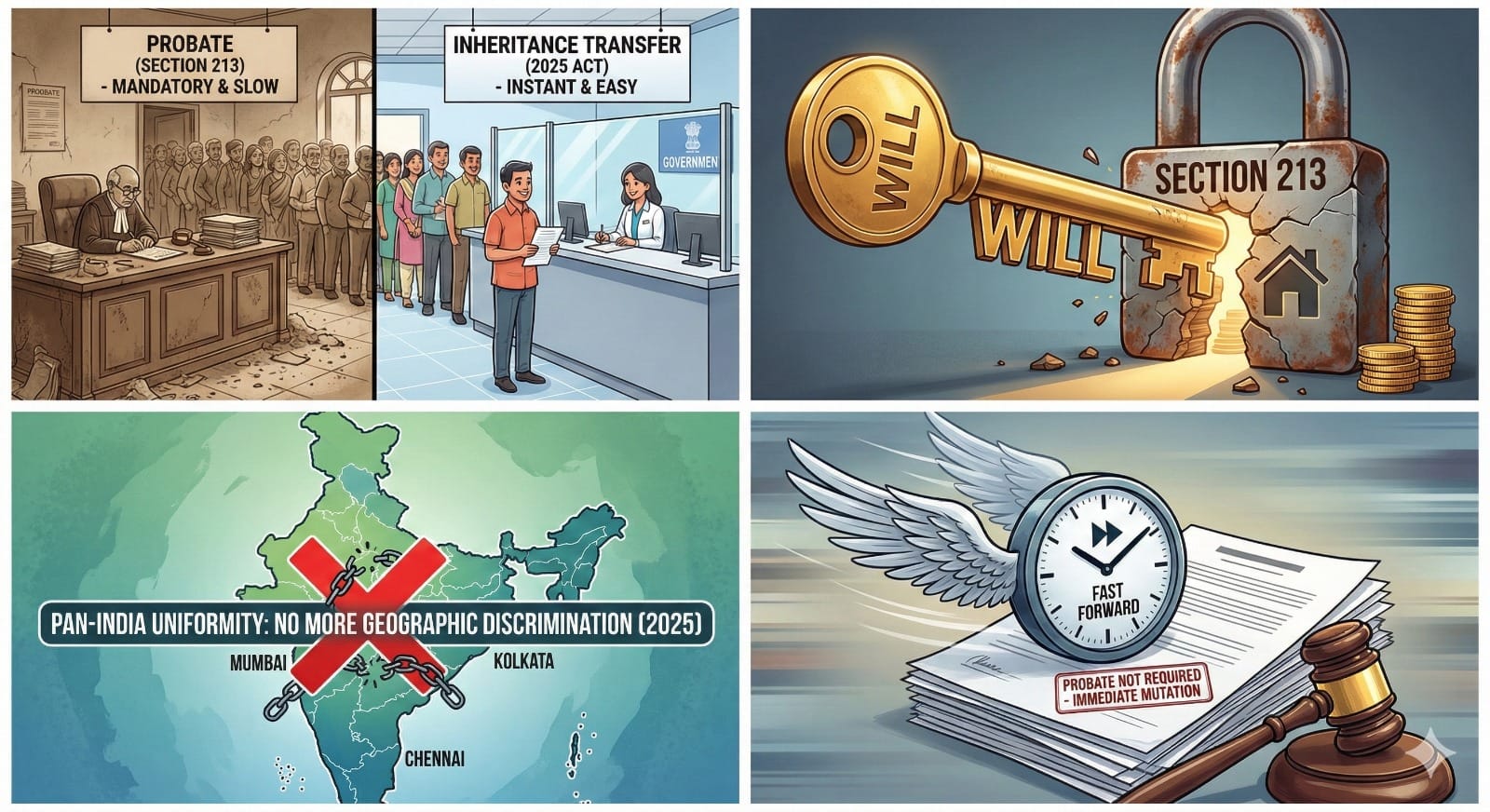
3. Uniformity: Equality for All Metros
Perhaps the most archaic aspect of Section 213 was its arbitrary geography. The mandatory rule applied specifically to Wills executed in the Presidency Towns (Mumbai, Chennai, Kolkata).
This created a discriminatory legal regime. Why should inheriting a flat in Bandra require a court order, while inheriting a villa in Gurgaon does not? The amendment has finally flattened the map. Whether your property is in Park Street or Pune, the law is now uniform.
At Vijay Foundation, we believe legal rights should be accessible to all. Support our Legal Awareness Initiatives to help us reach more families.
The “Safety First” Caveat
While the omission of Section 213 is cause for celebration, it is vital to understand that Probate in India 2026 is optional, not illegal.
- The Contested Will: If you anticipate a challenge, obtaining a court order is still the “Gold Standard.”
- High-Value Sales: Banks may still insist on a probated will for absolute title certainty.
Conclusion
The changes to the law represent a triumph of modern legal reform over colonial inertia. It shifts the power from the courts back to the family. While the option to seek court protection remains, the obligation to do so is finally history.
Share this update: