
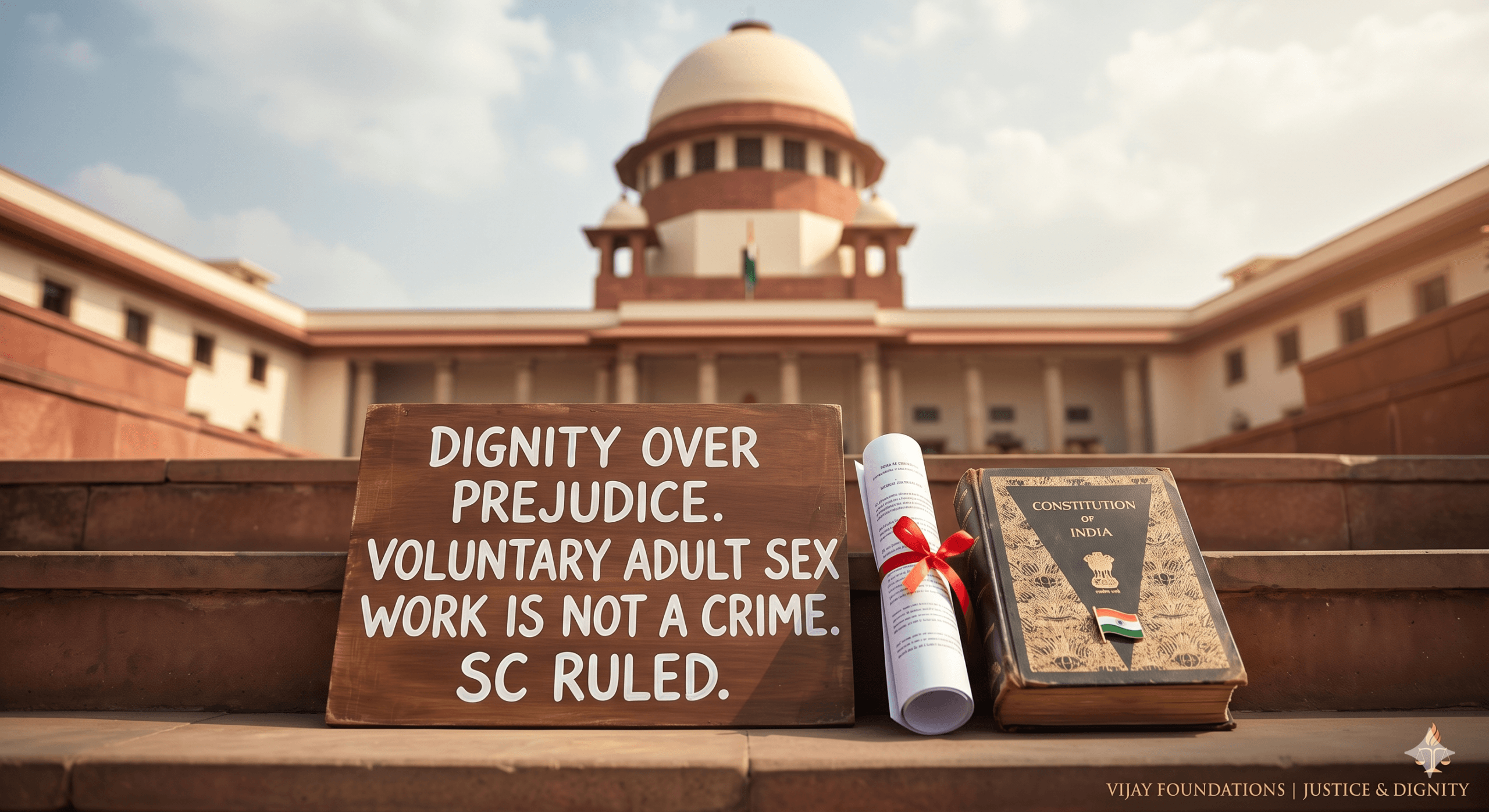
Adults in the Room: The Supreme Court Did Well to Liberate Voluntary Adult Sex Workers
They are neither victim nor offender — they are citizens. A landmark ruling finally puts constitutional dignity before moral prejudice.
For decades, the Indian state has operated with a peculiar contradition at its heart: voluntary sex work is not illegal, yet sex workers are routinely arrested, harassed, rescued against their will, and stripped of the dignity that every citizen is constitutionally guaranteed. That contradiction has now been confronted head-on by the landmark Supreme Court voluntary sex workers ruling — a sustained series of directions that collectively constitute one of the most meaningful judicial interventions for a historically invisible community.
The Court's position, articulated most forcefully in Budhadev Karmaskar v. State of West Bengal and reaffirmed in the 2026 ruling in Prajwala v. Union of India, is elegantly simple: if an adult woman chooses to engage in sex work of her own free will, the state has no business arresting, penalising, or "rescuing" her. She is an adult exercising agency over her own body. That is not a crime. That is a constitutional right.
"Sex workers are a section of society which has not only been forgotten but no one wants to even think about them. They are not even treated as human beings."
— Supreme Court of India, Budhadev Karmaskar v. State of West Bengal (2022)
The Legal Landscape Before the Supreme Court Voluntary Sex Workers Directives
The Immoral Traffic (Prevention) Act, 1956 (ITPA) has long been the statutory framework governing sex work in India. Contrary to popular belief, the ITPA does not criminalise voluntary sex work between consenting adults. What it prohibits is the running of a brothel, pimping, soliciting in a public place, and the exploitation of trafficked persons. Individual voluntary sex work, performed without coercion, was never made illegal under the Act.
Yet the lived reality of sex workers told a radically different story. Police raids on brothels invariably swept up voluntary sex workers alongside trafficking victims, treating all women as presumptive victims — and often, in practice, as criminals. Being "rescued" meant being detained in a protective home, sometimes for months or years, without consent or recourse. The apparatus meant to protect them became the instrument of their oppression.
It was this yawning gap between law on paper and law in practice that the Supreme Court set about closing — slowly, methodically, over a period spanning more than a decade.
What the Court Actually Said
- Sex workers are entitled to equal protection of the law under Article 14 and the right to life with dignity under Article 21 of the Constitution.
- When a sex worker is an adult and participating with consent, the police must refrain from interfering or taking any criminal action.
- Voluntary adult sex workers must not be arrested, penalised, harassed, or victimised during raids on brothels.
- Adult sex workers found in brothels during raids must not be subjected to rescue or detention mechanisms unless they explicitly consent.
- Possession of condoms shall not be treated as evidence of an offence or used to harass sex workers.
- Police and law enforcement agencies must be sensitised to the rights and dignity of sex workers.
- Sex workers who are victims of sexual assault are entitled to all facilities available to other survivors under the law.
- State governments are directed to review cases of adult women in protective homes who are detained against their will.
These are not merely progressive recommendations. They are binding constitutional directions, flowing from the fundamental rights of citizenship. By enforcing the Supreme Court voluntary sex workers guidelines, the Court has, in effect, told the state that its centuries-old conflation of sex work with trafficking — and of sex workers with either victims or criminals — is constitutionally indefensible.
Neither Victim Nor Offender: The Dignity Framework
The most profound shift in the Court's reasoning is the deployment of a dignity framework rather than a morality framework. For too long, policy on sex work in India has been shaped by one of two equally infantilising narratives: either sex workers are tragic fallen women in need of rescue and rehabilitation, or they are dangerous moral pollutants who must be contained. The Supreme Court has, admirably, rejected both.
By grounding its directions in Article 21 of the Constitution — the right to life and personal liberty — the Court recognises that bodily autonomy is non-negotiable. An adult woman's choice about what she does with her own body, under conditions of genuine consent, is a matter of personal liberty that the state may not override in the name of morality, welfare, or social order.
This is the correct constitutional position. It aligns with the right to privacy as affirmed in Puttaswamy v. Union of India (2017), where a nine-judge bench of this Court held that the right to privacy encompasses the right to make personal choices regarding intimate matters. A more powerful set of precedents could scarcely be imagined.
Why This Ruling Is Correct — and Necessary
On the distinction between trafficking and voluntary work
The fundamental error in how India has historically addressed sex work is the failure to distinguish between trafficking and voluntary adult sex work. They are not merely different in degree — they are different in kind. Trafficking is a heinous crime involving coercion, deception, and the total violation of a person's agency. Voluntary sex work involves none of these elements. Treating them identically is not just legally unsound; it actively harms both groups. It diverts law enforcement resources from genuine trafficking victims, and it subjects women who have chosen their profession to the same punitive apparatus designed for exploiters.
The Court is right to insist on this distinction. The United Nations Protocol to Prevent, Suppress and Punish Trafficking in Persons makes precisely this distinction at the international level. India's own constitutional framework demands it.
On the failure of the protective state
The data on "protective homes" — the state-run institutions to which rescued sex workers are sent — is damning. Reports by the National Human Rights Commission and multiple civil society organisations have documented overcrowding, poor living conditions, denial of legal assistance, and indefinite detention without any meaningful review mechanism. Women who have committed no offence are incarcerated in institutions they cannot leave. The "protection" of the state becomes indistinguishable from punishment.
The Supreme Court's direction to review all cases of adult women detained in protective homes against their will is therefore not a small procedural fix — it is a potential release from an unjust and prolonged deprivation of liberty for thousands of women.
On condoms and public health
One of the most practically consequential directions in the ruling is the prohibition on treating condom possession as evidence of an offence. The logic of using condoms as proof of sex work — and therefore as grounds for arrest or harassment — is grotesque in its public health implications. It directly discourages condom use in a population that is among the most vulnerable to sexually transmitted infections, including HIV. As the UNAIDS country report on India has noted, the 2022 ruling brought India into alignment with a small number of countries — including Canada and New Zealand — that have explicitly instituted legal protections for sex workers, a critical step for ending AIDS.
The Road Ahead: What Remains Unfinished
To be clear: the Supreme Court's directions, however welcome, are not a complete solution. They are a judicial stopgap in the absence of legislation. The Trafficking in Persons (Prevention, Care and Rehabilitation) Bill, which was to have codified many of these protections, has been pending in various forms since 2018. The Union Government's continued delay in passing this legislation is an abrogation of its constitutional obligations.
Furthermore, judicial directions do not automatically change police culture. The sensitisation of law enforcement — which the Court has directed — requires sustained training, accountability mechanisms, and institutional reform. The gap between a Supreme Court order and the reality of a midnight raid in a red-light district of Kolkata, Mumbai, or Delhi remains enormous.
Civil society organisations, advocates, and collectives such as the All-India Network of Sex Workers (AINSW) have been doing this work on the ground for decades. Their expertise, perspectives, and voices must be centred in any legislative or policy reform that follows from these judicial directions.
A society that criminalises the choices of its most marginalised members — while ignoring the structures that marginalise them — has confused cause with consequence.
A Note on Language and Stigma
The Supreme Court's own language in this case is notable for its deliberate effort to treat sex workers as full persons rather than social problems. This matters more than it may appear. Language shapes policy, and policy shapes lives. When the law speaks of sex workers as citizens entitled to equal protection — rather than as fallen women, public nuisances, or vectors of disease — it does something significant: it refuses to endorse the stigma that has been the primary instrument of their oppression.
For those of us in the legal community, the ruling is also a reminder of what the Constitution actually says. Article 21 guarantees life and liberty to every person. Article 14 guarantees equality before the law to every person. Article 19 protects the right to practice any profession. These are not conditional rights, available only to those whose professions attract social approval. They are universal. The Supreme Court, in this ruling, has simply remembered what the Constitution always said.
Conclusion
The Supreme Court voluntary sex workers position is constitutionally correct, morally coherent, and long overdue. It does not legalise exploitation. It does not sanction trafficking. It does not endorse any particular view of sex work as a social phenomenon. What it does is insist, firmly and clearly, that adults who make consensual choices about their own bodies are neither victims requiring rescue nor criminals requiring punishment. They are people — citizens — entitled to the same dignity, safety, and legal protection as anyone else.
That is not a radical proposition. It is the bare minimum that a constitutional democracy owes to every one of its citizens. The Court deserves credit for saying so. The government now has an obligation to act on it.
Adv. Mamta Shukla is a human rights lawyer and contributor to Vijay Foundations. Her practice focuses on constitutional law, gender justice, and access to legal aid. The views expressed are her own. This article is for informational purposes and does not constitute legal advice.