Jantar Mantar Protest Venue De-Notified: 3 New Sites & Legal Rights
Delhi Police has withdrawn the Jantar Mantar protest venue designation and named Ramlila Ground, Burari Ground, and CBD Ground in East Delhi as the three new venues. The change follows a Home Ministry committee's recommendations, while revised procedures remain awaited.
Introduction: End of the Jantar Mantar Protest Venue Era
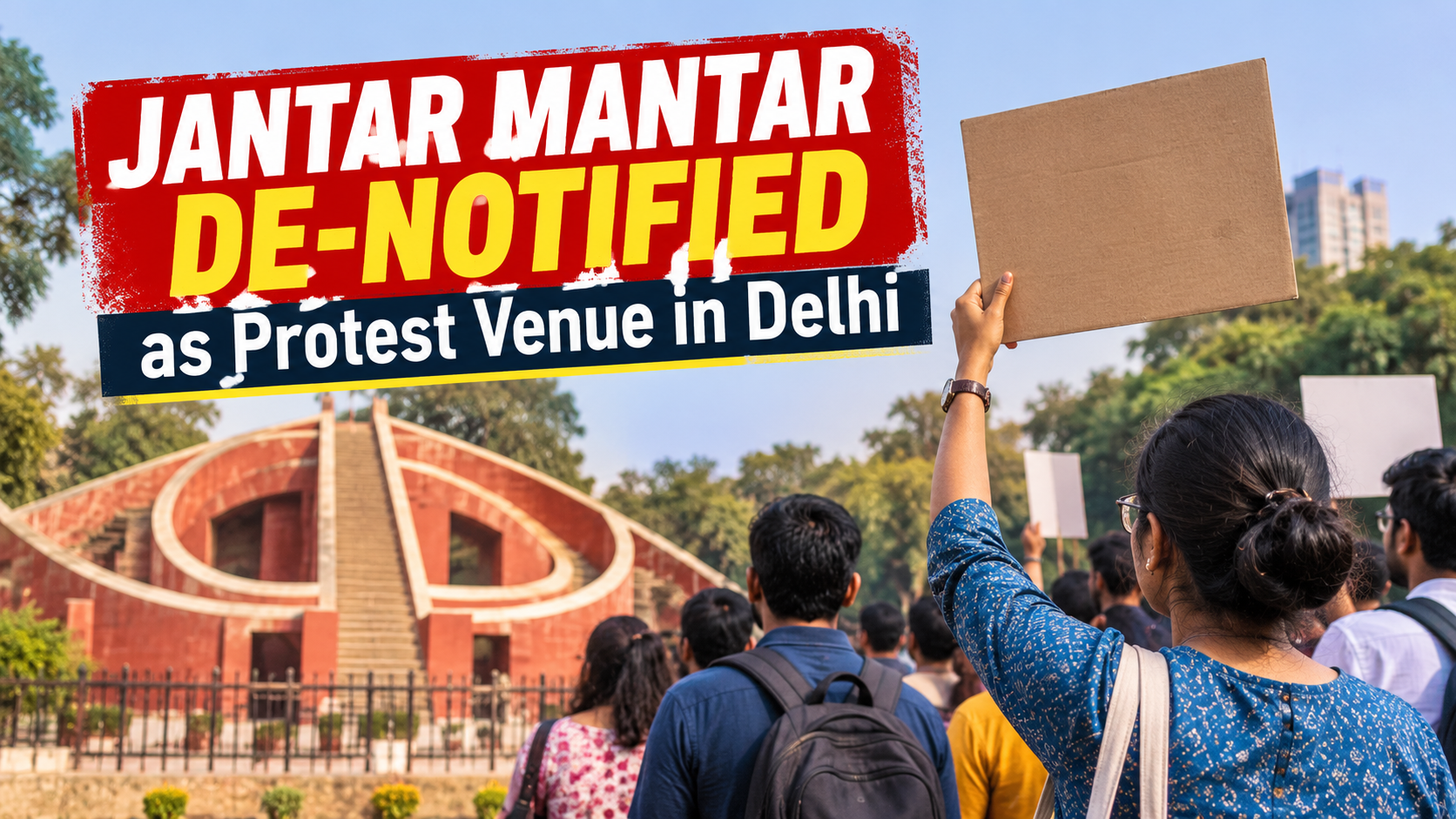
For decades, the Jantar Mantar protest venue has been the place where Delhi's demonstrators came to be heard. Its proximity to Parliament and central government offices made it the natural stage for causes ranging from labour rights to electoral reform. On 11 October 2026, the Delhi Police Commissioner issued Standing Order L&O/48/2026, officially removing Jantar Mantar as a designated protest site.
The order names three replacements: Ramlila Ground, Burari Ground, and CBD Ground in East Delhi. It states that the change follows recommendations from a committee constituted by the Union Ministry of Home Affairs—prompted by Supreme Court observations regarding ingress, egress, and basic amenities at the site. The order also notes that a detailed, revised procedure for protests at the three new venues will be issued separately. This article explains what the order says, the constitutional framework that applies, and the practical challenges citizens face.
- Delhi Police removed the Jantar Mantar protest venue status under Standing Order L&O/48/2026 dated 11 October 2026, modifying the earlier standing order of 28 April 2022.
- Ramlila Ground, Burari Ground, and CBD Ground in East Delhi are the three new designated grounds, while revised standard operating procedures (SOPs) are still pending.
- While the right to peaceful protest is constitutionally protected, the State may regulate the time, place, and manner of demonstrations—provided alternative venues remain reasonable and accessible.
The Legislative and Regulatory Backbone
Article 19(1)(a) of the Constitution guarantees freedom of speech and expression. Article 19(1)(b) guarantees the right of citizens to assemble peacefully and without arms. Together, these provisions form the basis of the constitutional right to protest, which the Supreme Court has consistently recognised as integral to a functioning democracy.
Article 19(3) allows the State to impose reasonable restrictions on the right to assemble in the interest of public order, along with the sovereignty and integrity of India. Any restriction must be reasonable, proportionate, and directly connected to one of the grounds listed in Article 19(3).
Delhi Police standing orders are administrative instruments, not statutes passed by Parliament. The earlier standing order of 28 April 2022 governed permissions for protests in Delhi, and Standing Order L&O/48/2026 modifies that framework. Readers should distinguish between this administrative venue designation and statutory powers governing public order, including preventive orders under Section 163 of the Bharatiya Nagarik Suraksha Sanhita, 2023 (BNSS), which replaced Section 144 of the Code of Criminal Procedure, 1973.
Who Is Affected by the Jantar Mantar Protest Venue Shift?
- Individuals and citizen groups planning demonstrations, sit-ins, or peaceful assemblies in New Delhi.
- Political parties, trade unions, and civil society organisations that have historically relied on central Delhi visibility.
- Residents near the new venues, who may experience changes in local traffic and public use of grounds like Burari and CBD Ground.
- Police and civic bodies, including the Delhi Development Authority (DDA), which manages land permissions for several designated grounds.
Judicial Interpretation and Precedents
The Ramlila Maidan Incident (2012)
In Ramlila Maidan Incident v. Home Secretary, Union of India, (2012) 5 SCC 1, the Supreme Court examined police action against a peaceful gathering. The Court held that citizens possess a fundamental right to peaceful assembly and protest that cannot be curtailed by arbitrary executive action. Preventive prohibitory orders must be grounded in actual, reasonably apprehended threats to public order rather than speculative convenience.
The NGT Ban on Protests at Jantar Mantar (2017)
On 5 October 2017, the National Green Tribunal ordered a complete ban on protests at Jantar Mantar on environmental and noise pollution grounds, directing demonstrators to Ramlila Maidan. That blanket ban was subsequently challenged before the Supreme Court.
Mazdoor Kisan Shakti Sangathan v. Union of India (2018)
In its landmark judgment of 23 July 2018, a bench of Justices A.K. Sikri and Ashok Bhushan set aside the blanket prohibition. The Court ruled that there cannot be a total ban on protests in central Delhi, including at the Jantar Mantar protest venue. At the same time, it recognised that authorities may regulate the time, place, and manner of demonstrations to balance protesters' rights with public order and residents' rights, directing the formulation of a fair regulatory mechanism.
2026 Developments and Pending Court Challenges
In October 2026, following observations by a Supreme Court bench regarding overcrowding, lack of sanitation, and emergency access at Jantar Mantar, a Union Home Ministry committee recommended shifting demonstrations. Immediately after Delhi Police issued the 11 October de-notification order, petitioners challenged the move before the Delhi High Court, arguing that removing central Delhi access undermines effective dissent.
Rights, Liabilities and Practical Steps
Your rights as a citizen. You retain a constitutional right to assemble peacefully without arms and express your views publicly. Designating specific grounds is a regulatory mechanism, not an extinguishment of Article 19 rights.
Your duties as a protester. Organisers and participants must comply with lawful police directions, adhere to permitted headcounts and timings, and ensure assemblies remain peaceful.
Institutional responsibilities. Authorities must publish clear, accessible rules. Recent reports indicate confusion among citizen groups caught between Delhi Police stations and land-owning agencies like the DDA when applying for permits at Burari or CBD Ground. Clear single-window procedures are essential for administrative fairness.
Practical Scenario: What Should You Do?
This scenario is hypothetical and included for illustrative explanation only.
A group of residents in South Delhi plans a peaceful demonstration regarding a local civic issue. Having previously gathered at the Jantar Mantar protest venue, they want to ensure their upcoming assembly is lawful.
- Verify the current standing order: Obtain a copy of Standing Order L&O/48/2026 and check whether the revised SOP has been notified on the Delhi Police website.
- Select an appropriate designated venue: Choose between Ramlila Ground, Burari Ground, or CBD Ground based on expected crowd size and Metro connectivity.
- Check dual-agency permissions: Confirm whether you need both a No Objection Certificate (NOC) from the Delhi Police and a ground booking from the land-owning agency (such as the MCD or DDA).
- Keep the gathering peaceful: Strictly observe approved hours, sound limits, and crowd caps.
- Maintain written records: Keep stamped copies of all applications, online portal receipts, and police communications.
- Consult an advocate if refused: If permission is denied arbitrarily or delayed without reason, seek legal advice to pursue appropriate remedies before the High Court.
Common Mistakes People Make
- Assuming Jantar Mantar still accepts protest applications. Because the Jantar Mantar protest venue stands de-notified, local police stations are rejecting applications for that site.
- Ignoring land-owning agency approvals. Applying only to the police without booking the ground through the DDA or municipal authority can lead to last-minute cancellation or removal of tents.
- Relying on unverified social media forwards. Always verify venue rules directly from official Delhi Police notices.
- Gathering without written confirmation. Even a peaceful assembly risks dispersal under BNSS provisions if prior procedural requirements are bypassed.
What You Should Do
- Check both Delhi Police and land-owning agency (DDA/MCD) requirements before fixing a protest date.
- Apply well in advance and retain written proof of your submission.
- Keep demonstrations peaceful, orderly, and within permitted boundaries.
- Seek timely legal counsel if permissions are unreasonably withheld.
What You Should Avoid
- Do not assume a demonstration is automatically exempt from venue rules simply because it is small or peaceful.
- Do not block arterial roads, hospital access, or public transit hubs.
- Do not circulate unverified claims regarding court stays or venue reopenings.
Critical Analysis and the Road Ahead
The de-notification order highlights the ongoing tension between urban management in the national capital and the democratic necessity of visible public dissent. While shifting large gatherings away from congested central corridors addresses logistical and safety concerns, relocating protesters to peripheral grounds like Burari or East Delhi risks diminishing the visibility that gives peaceful protest its constitutional meaning.
Furthermore, issuing a de-notification order before publishing the revised SOP creates an administrative vacuum. Constructive steps the authorities should prioritise include:
- Publish the revised SOP immediately: Eliminate ambiguity by releasing clear, uniform guidelines on application timelines, permissible group sizes, and permitted equipment.
- Establish a single-window clearance portal: Coordinate between Delhi Police, DDA, and MCD so citizens are not forced to shuttle between offices for a single peaceful gathering.
- Ensure basic civic amenities: Guarantee drinking water, sanitation, shade, and medical access at all three designated grounds.
- Preserve central visibility: Ensure that Ramlila Ground remains genuinely accessible for smaller, peaceful citizen groups without prohibitive fees or bureaucratic hurdles.
Conclusion
Removing the Jantar Mantar protest venue designation is an administrative decision with deep constitutional implications. As the Supreme Court affirmed in 2018, the State may regulate the time, place, and manner of protests, but regulation cannot become so burdensome that it hollows out Article 19(1)(a) and 19(1)(b). Until the revised procedures are finalised and tested in the pending Delhi High Court proceedings, organisers must navigate the new three-venue framework carefully and document every step.
Read more on Vijay Foundation: Explore Vijay Foundation's legal awareness resources
Frequently Asked Questions
1. Is protest banned at the Jantar Mantar protest venue now?
Yes, Jantar Mantar is no longer a designated protest site under Standing Order L&O/48/2026 dated 11 October 2026. Delhi Police is no longer granting permissions for demonstrations at the site.
2. Which are the three new protest venues in Delhi?
Delhi Police has designated Ramlila Ground, Burari Ground, and CBD Ground in East Delhi as the three alternative venues for protests and demonstrations.
3. Does the Indian Constitution protect the right to protest?
Yes. The Supreme Court has held that the right to peaceful protest flows from freedom of speech and expression under Article 19(1)(a) and the right to assemble peacefully without arms under Article 19(1)(b), subject to reasonable restrictions under Article 19(3).
4. What did the Supreme Court say in the 2018 Jantar Mantar case?
In Mazdoor Kisan Shakti Sangathan v. Union of India (2018), the Supreme Court struck down a blanket ban on protests in central Delhi and held that authorities may regulate the time, place, and manner of demonstrations rather than imposing total prohibitions.
5. How can organisers apply for protest permission at the new venues?
Organisers should check the latest standing order with the concerned DCP office and verify whether separate ground-booking permission is required from the land-owning agency (such as DDA or MCD) well ahead of the proposed date.
Disclaimer: This article is intended for general legal awareness and informational purposes only. It does not constitute case-specific legal advice. The applicable legal position may depend on the facts and circumstances of each matter.
Sources and Authoritative References
- India Code (Constitution of India, BNSS 2023 and related statutes)
- Supreme Court of India (Mazdoor Kisan Shakti Sangathan v. Union of India, judgment of 23 July 2018)
- Delhi Police Standing Order No. L&O/48/2026 (dated 11 October 2026)
- Reports consulted: The Indian Express, Bar & Bench, LiveLaw, LawBeat, ANI, India Today